

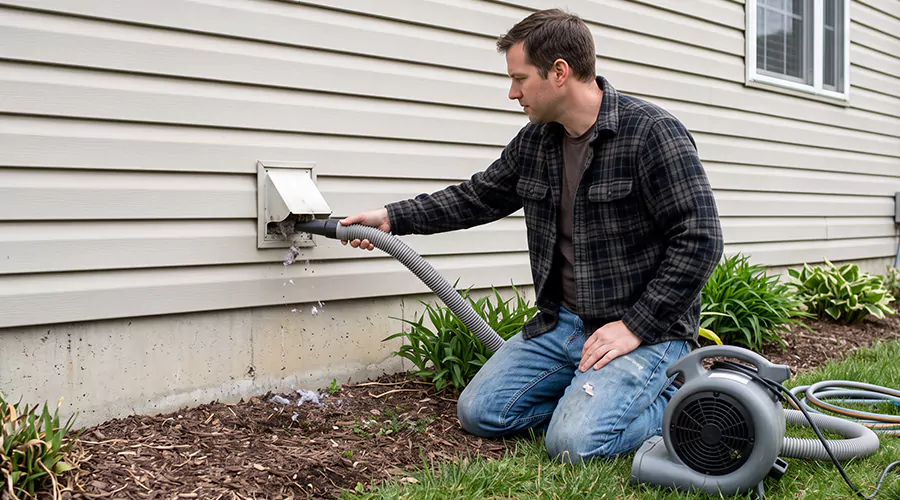
Blowing out a dryer vent means using moving air to carry loose lint through the exhaust duct toward an open collection or discharge point. A controlled airflow method may help clear residual debris after brushing, but it is not a reliable substitute for physically removing heavy buildup. Using an ordinary leaf blower or air compressor without checking the duct can damage concealed connections or scatter lint into unintended spaces.
A dryer exhaust system is designed to carry warm, moisture-laden air from the appliance to the outdoors. Some lint escapes the dryer's filter and collects inside the duct over time. As buildup increases, the airflow becomes restricted, and clothes may require longer drying cycles.
The idea behind blowing out a dryer vent is simple. Moving air carries loosened fibers toward an outlet where they can be collected or discharged safely. However, an improperly connected duct or a tightly packed obstruction can prevent that air from following the expected path.
A proper blow-out method therefore begins with inspecting the exhaust and identifying where the debris will travel. The most effective cleaning often combines controlled airflow with brushing and vacuum collection. A professional dryer vent cleaning service can help remove stubborn lint buildup while reducing the risk of duct damage. Understanding when the method is appropriate helps prevent damage while restoring normal dryer performance.
What Does It Mean to Blow Out a Dryer Vent?
Blowing out a dryer vent refers to using airflow to move lint from inside the exhaust duct. The air may be supplied by specialized professional equipment or by the dryer itself during a final operational check after cleaning. The method is intended to move loose particles out of the passage.
It differs from brushing because the airflow does not physically scrub the duct wall. A brush can loosen deposits attached to the surface, while moving air helps transport fibers that have already been disturbed. The two methods can complement one another when used correctly.
A blow-out is less effective when lint has become tightly packed around a bend or lodged near the outdoor damper. In those situations, the air may pass around part of the blockage without removing it. Greater pressure can also place unnecessary stress on duct connections.
The purpose should be removing debris from the exhaust system rather than simply making lint disappear from the accessible opening. A successful cleaning leaves the passage clear and confirms that the outdoor termination operates normally.
Can You Blow Out a Dryer Vent With a Leaf Blower?
Some people use a leaf blower to push lint from a dryer exhaust toward the outdoor opening. Although a blower can move loose fibers through certain short, sound ducts, this improvised method has important limitations. It should not be treated as a universally safe replacement for dryer vent brushing and vacuuming.
A leaf blower delivers a large volume of air and may not connect properly to the vent. If the exhaust contains a blockage or weak joint, air can escape through an unintended opening. Lint may then enter a concealed wall or attic space rather than leave the building.
A leaf blower can also scatter large quantities of lint around the exterior termination. This creates a cleanup problem and can release particles near windows or neighboring buildings. The presence of discharged lint does not prove that all deposits have been removed.
For these reasons, household cleaning with a dryer-rated brush and vacuum is generally preferable. When powered airflow is required for a complicated vent, a qualified technician can assess the duct and use equipment designed for the task.
What Are the Main Methods for Blowing Out a Dryer Vent?
Several methods may move lint through a dryer exhaust, but they do not offer the same level of control. The appropriate choice depends on the duct's condition and how the loosened material will be collected. Airflow should never be used to force a path through unknown structural damage.
Controlled Professional Airflow Cleaning
Professional systems may use specialized airflow equipment to move loosened lint toward a designated outlet or collection point. The cleaner identifies the duct route and checks for weak connections before introducing additional airflow.
The equipment should allow the operator to manage where air and debris travel. This is particularly important when the exhaust passes through concealed walls or ceilings. A damaged joint can otherwise allow lint to escape into a building cavity.
Pneumatic Dryer Vent Cleaning Tools
Some professional cleaners use compressed-air tools that loosen lint through directional jets or pneumatic agitation. These tools operate according to their manufacturer's requirements and may be paired with collection equipment. They are different from an ordinary household air gun connected directly to a compressor.
The operator needs to control both the cleaning tool and the released debris. Compressed air does not automatically remove a compacted blockage or repair a disconnected duct. The method should be selected only after evaluating the actual exhaust conditions.
Mechanical Brushing Followed by an Airflow Check
A more practical method for many accessible residential vents is to loosen and collect lint with a dryer-specific brush and vacuum. After the system is fully reconnected, normal dryer airflow can be checked at the exterior termination.
This final check may move a small amount of residual loose material through the exhaust, but it should not be used to clear an active blockage. The duct needs to be cleaned first. If the dryer overheats or produces a burning smell, it should not be operated merely to blow remaining lint out.
When Is Blowing Out a Dryer Vent Appropriate?
Controlled airflow may be useful when the duct is structurally sound and loose lint can move through a known route. It is less suitable for heavy obstructions or concealed sections with uncertain connections. Assessing the duct before cleaning helps prevent the airflow from being directed into an unintended space.
| Vent Condition | Is a Blow-Out Method Appropriate? | Better Approach |
|---|---|---|
| Light loose lint in sound metal duct | May be useful as part of controlled cleaning | Brush and collect debris first |
| Short accessible vent | Additional airflow often unnecessary | Dryer brush and vacuum |
| Long concealed duct | Requires assessment | Professional cleaning |
| Thick compacted lint blockage | Not as a first method | Mechanical removal and inspection |
| Crushed transition hose | No | Replace damaged connector |
| Disconnected concealed joint | No | Repair connection |
| Blocked outdoor damper | Not until cleared | Remove obstruction safely |
| Roof termination | Requires specialized access | Professional service |
A blow-out method should never be used to compensate for an improperly designed exhaust system. An excessively long duct or one with too many elbows can remain restrictive even after lint is removed. The vent configuration must meet the dryer manufacturer's instructions.
What Tools Are Used to Blow Out a Dryer Vent?
Professional airflow cleaning may require a suitable blower or pneumatic system along with equipment for collecting dislodged lint. A camera may be used to inspect difficult bends and confirm that the duct remains intact. The exact equipment depends on the duct length and material.
A suitable cleaning setup may involve:
- Equipment specifically intended for dryer exhaust cleaning
- Compatible airflow nozzle or pneumatic attachment
- Suitable vacuum or lint collection system
- Dryer vent brush for loosening deposits
- Inspection camera for concealed sections
- Appropriate connection tools
- Work gloves and suitable eye protection
- Airflow measurement equipment
- Manufacturer instructions for the cleaning tools and dryer
Not every task requires all of these tools. A short residential wall vent may be cleaned adequately using a brush and vacuum without additional powered airflow. A long concealed system may require specialized access and equipment.
Avoid improvising airtight connections between a household leaf blower and an unknown duct. The ability to produce airflow does not mean the equipment can safely handle a blocked exhaust passage.
How to Blow Out a Dryer Vent Safely Step by Step?
A controlled dryer vent blow-out should be performed only after the duct's condition and discharge route have been checked. The steps below describe how a qualified cleaner approaches an airflow-assisted cleaning. For homeowners, they also show which preparation and inspection tasks can be completed without forcing additional air into the duct.
Step 1. Turn Off and Disconnect the Dryer
Switch off the appliance and disconnect it from electrical power before accessing the exhaust. Allow the dryer to cool completely. Do not insert tools or connect external airflow equipment while the dryer is running.
For a gas dryer, the fuel connection must not be stretched or disturbed during access. If moving the appliance requires disconnecting the gas supply, qualified service is necessary. The connection must be properly restored before the dryer is operated again.
Step 2. Find the Outdoor Exhaust Termination
Determine where the dryer exhaust leaves the building. The termination may be through an exterior wall or roof. Identifying the outlet is necessary because the cleaning process must account for where lint will travel.
Inspect the exterior damper from a safe location. A blocked or damaged termination can prevent airflow from leaving the duct. Do not force air into the passage while the outlet remains obstructed.
Step 3. Check the Exhaust Material
Identify whether the permanent duct is sound metal and whether the transition section is approved for dryer use. Look for crushing or visible separation around accessible fittings. Fragile or damaged material may not tolerate additional cleaning airflow.
Plastic and unsuitable foil-style accordion hoses should not be treated as acceptable permanent dryer exhaust ducts. These materials may restrict airflow and create additional hazards. Replacement is generally preferable when an unapproved or badly damaged section is found.
Step 4. Inspect for Major Blockages
Use accessible openings and suitable inspection methods to look for substantial lint deposits or nesting material. A heavily blocked duct should be cleared using a method appropriate for the obstruction. Simply increasing airflow may push the blockage farther into the passage.
A professional may use a camera to examine concealed bends. This can help identify a crushed duct or separated joint that would otherwise remain hidden. The inspection determines whether an airflow-assisted method is appropriate.
Step 5. Remove Loose Lint Near the Dryer
Use a vacuum or dryer-rated brush to collect accessible lint from the exhaust entrance. This reduces the amount of material that could be blown back into the laundry room. The lint filter housing may also need ordinary maintenance according to the dryer manufacturer's instructions.
Removing nearby material first provides a cleaner access point for additional work. A thick deposit should not be pushed into the permanent duct as a shortcut. The objective is controlled removal, not relocating the restriction.
Step 6. Loosen Deposits Using a Suitable Brush
Mechanical brushing may be needed to release lint that has adhered to the duct walls. A dryer-specific brush is advanced through compatible sections using the tool manufacturer's instructions. The brush should move without damaging fittings or catching on sharp bends.
Do not use a plumbing auger or force a rotating brush through a major blockage. If resistance occurs, the cleaner should identify the cause before continuing. A structural defect requires repair rather than stronger agitation.
Step 7. Prepare the Controlled Airflow System
When a professional blow-out method is appropriate, the equipment is connected according to its specifications. The cleaner establishes where lint will be collected or discharged. Any outdoor discharge area should be managed so debris does not enter building openings.
The setup should prevent excessive pressure from accumulating inside the duct. It should not rely on forcing air against a sealed or unknown obstruction. Equipment ratings and the actual duct condition determine the permissible operating method.
Step 8. Move Loosened Lint Toward the Collection Point
The operator uses controlled airflow to transport loosened lint through suitable sections of the exhaust. The direction depends on the equipment and the chosen collection method. The process should not scatter material into occupied rooms or hidden cavities.
If airflow stops or the tool encounters unexpected resistance, cleaning should pause for inspection. Increasing pressure can damage weak connections without removing the blockage. A suitable method should allow debris to move through a known open path.
Step 9. Collect and Remove the Debris
Loosened lint should be collected using appropriate equipment or removed from a controlled outdoor discharge area. The cleaner should check for material remaining near accessible elbows or the termination. Lint left behind may create another restriction during normal dryer operation.
Visible lint exiting the duct is not proof that the passage has been completely cleaned. Debris can remain attached to the walls or trapped at sharp bends. Further inspection may be necessary when the duct has a complicated route.
Step 10. Inspect the Exterior Damper
The outdoor damper should move freely after the cleaning is complete. Remove remaining lint that may be collected around the opening. The termination should discharge outdoors without a mesh screen that traps fibers.
A roof outlet should be accessed only with suitable safety equipment and trained personnel. The cleaning process should not damage roof flashing or leave the termination improperly installed. A clear duct is not sufficient if the outdoor hood remains obstructed.
Step 11. Check Duct Connections
Inspect accessible joints for signs of movement or separation after the airflow-assisted cleaning. Confirm that the transition duct and permanent exhaust remain connected. Any damaged fitting should be repaired before the dryer returns to service.
This step is especially important when a blockage was found near a bend or connection. A joint that has separated can release lint and moisture into the building. The system must remain structurally sound as well as clear.
Step 12. Reconnect and Test the Dryer
Restore the dryer exhaust connection using approved materials and make sure the transition duct is not crushed behind the appliance. Return electrical power only after the system has been fully reassembled. Gas connections must be checked appropriately if professional service required them to be disturbed.
Run a normal test according to the appliance manufacturer's instructions. Check the exterior airflow and damper movement from a safe location. If the dryer still overheats or dries poorly, stop operation and arrange further diagnosis rather than repeating the blow-out process.
What Happens if You Blow Air Into a Completely Blocked Dryer Vent?
A complete blockage prevents exhaust air from moving through the intended passage. When additional air is forced into the duct, it may escape through weak connections or openings rather than pass through the obstruction. This can create damage without clearing the restriction.
For example, a heavy lint plug near an elbow may remain in place while airflow stresses a loose joint behind the wall. If the joint separates, lint and air may enter the concealed cavity. The resulting problem can be difficult to identify from the laundry room.
A blocked dryer vent therefore requires locating and removing the obstruction, not simply applying greater airflow. Mechanical cleaning or direct access may be needed when the material is tightly packed. A collapsed duct must be repaired or replaced before normal discharge can be restored.
Does Blowing Out a Dryer Vent Work Better Than Vacuuming?
Blowing and vacuuming move debris in different ways. Blowing applies airflow intended to transport lint, while vacuuming collects material through suction. Mechanical brushing is often used alongside either method to loosen deposits attached to the duct walls.
For many short accessible exhausts, brushing and vacuum collection offer a practical household method. Blowing alone may move loose lint but leave attached deposits behind. It can also create a mess when debris is discharged without collection controls.
| Method | Main Advantage | Limitation |
|---|---|---|
| Vacuuming | Collects accessible lint | Reach may be limited |
| Dryer vent brush | Loosens deposits on duct walls | Can snag at bends |
| Brush with vacuum | Loosens and collects material | Requires suitable duct access |
| Controlled professional airflow | Can move loose lint through suitable passages | Needs proper containment and inspection |
| Household leaf blower | Moves a high volume of air | May scatter lint or stress weak connections |
| General-purpose compressed-air gun | Can dislodge loose particles | Not a complete dryer-vent cleaning method |
The comparison shows why more airflow is not automatically better. The best method is the one that removes the material without damaging the vent. A properly cleaned duct should also be inspected for restrictions that cannot be corrected through lint removal.
Can You Blow Out a Dryer Vent From the Outside?
Some professional methods access the dryer exhaust from the exterior termination. The feasibility depends on the vent route and whether the outlet can be opened without damage. Cleaning from outside may be useful for certain configurations, but it should not push debris back toward the dryer or into concealed spaces.
A wall termination accessible from the ground may provide a practical inspection point. However, the damper and hood design can restrict access for cleaning tools. The exterior components should not be forced apart or damaged simply to insert equipment.
Roof vents introduce additional access hazards. Attempting to blow through a roof termination with an improvised tool can damage the cap or dislodge concealed debris. Qualified professionals should handle roof access and determine the appropriate cleaning direction.
How Do You Know if a Dryer Vent Blow-Out Was Successful?
A successful cleaning should remove the lint restriction and leave the exhaust passage properly connected. The outdoor damper should open during operation and close when the dryer stops. Normal loads should also dry within their expected time when the appliance itself is functioning correctly.
Several checks help evaluate the results:
- The transition duct remains securely attached.
- The outdoor termination is free from substantial lint.
- The damper opens normally during dryer operation.
- No cleaning tools or debris remain inside the passage.
- The duct has not become crushed or disconnected.
- Exhaust airflow has improved where a restriction existed.
- The dryer operates without unusual overheating symptoms.
- Drying performance returns to normal for ordinary loads.
These observations provide useful confirmation, but they cannot always identify hidden deposits. A complicated concealed duct may require professional inspection or airflow measurements. Repeated slow drying after cleaning suggests that the exhaust or appliance still needs attention.
What Mistakes Should You Avoid When Blowing Out a Dryer Vent?
Improper blow-out methods can damage ducts or leave a blockage farther inside the passage. The most serious mistake is forcing additional air into an unknown or fully blocked system. Proper inspection should come before any attempt to move lint with powered airflow.
Avoid these mistakes:
- Using an unrestricted leaf blower against a blockage. It can stress weak connections without removing the obstruction.
- Sealing an air hose tightly into an unknown duct. Pressure may build when the outlet is restricted.
- Blowing lint into an occupied room. Fine particles can spread instead of being collected.
- Ignoring the outdoor damper. A blocked termination can prevent debris from leaving.
- Increasing compressor pressure when airflow stops. The duct may be crushed or disconnected.
- Using plastic dryer exhaust material. Unsuitable ducting should be replaced.
- Operating the dryer with the exhaust disconnected. Hot, moist air and lint should discharge outdoors.
- Moving a gas dryer unsafely. The fuel line must not be stretched or disturbed.
- Climbing onto a roof without proper safety equipment. Roof access should be handled by qualified personnel.
- Assuming lint discharge proves complete cleaning. Material may remain farther inside the system.
- Leaving a damaged duct joint unrepaired. Lint may escape into a wall cavity.
- Continuing to run an overheating dryer. The cause requires investigation before normal use resumes.
Another mistake is using a blow-out method to compensate for poor duct design. A long exhaust with excessive bends may remain restrictive even when clean. The appropriate solution may involve correcting the duct route instead of repeatedly forcing air through it.
How Often Should You Blow Out a Dryer Vent?
Dryer vent cleaning should generally be completed about once a year, according to U.S. Fire Administration guidance. However, this does not mean that a powered blow-out is necessary during every cleaning. A dryer-rated brush and vacuum may be sufficient for many residential exhaust systems.
The appropriate maintenance interval depends on laundry volume and the vent's design. Long ducts and frequent dryer use may justify more frequent inspection. A sudden increase in drying time should be investigated regardless of the last cleaning date.
Lint filters need cleaning before or after every load. The outdoor termination should also be checked periodically for obstruction. These simple tasks can reduce the likelihood of heavy lint buildup that requires more involved removal.
When Should You Call a Professional Dryer Vent Cleaner?
A professional should evaluate a dryer exhaust when a blockage is severe or the duct route cannot be accessed safely. Long concealed passages and roof terminations may require inspection tools and specialized cleaning equipment. A technician can determine whether brushing or controlled airflow is appropriate.
Professional attention is also needed when the vent contains damaged joints or materials that are not suitable for dryer exhaust. A crushed transition hose cannot be repaired through airflow alone. Replacing the affected component may be necessary before cleaning can provide a lasting improvement.
If the dryer produces a burning smell or repeatedly overheats, stop using it until the cause has been corrected. Smoke or fire requires immediate emergency action. Routine cleaning should not be attempted while the appliance presents an active safety concern.
How Can You Prevent Dryer Vent Blockages After Cleaning?
Preventing recurring dryer vent problems begins with maintaining the lint screen and keeping the exhaust passage unrestricted. The duct should remain properly connected and free from unnecessary bends. Regular checks help identify restrictions before heavy lint buildup develops.
Clean the Lint Screen Every Load
Remove accumulated fibers after each drying cycle. Inspect the screen periodically for damage or residue that prevents normal airflow. Replace damaged filters with compatible parts recommended by the dryer manufacturer.
Maintain a Suitable Exhaust Connection
Inspect the transition duct for crushing when the dryer is moved for cleaning or maintenance. Use approved metal duct materials and avoid sharp bends behind the appliance. A properly routed connection helps maintain consistent exhaust airflow.
Keep the Exterior Outlet Clear
Check the outdoor damper for lint buildup and free movement. Remove accessible deposits when the dryer is off. Do not install a mesh screen across the termination because it can collect fibers and create another blockage.
Schedule Regular Duct Cleaning
Plan a full exhaust cleaning approximately once a year or sooner when drying performance declines. Record the date and any issues involving damaged ducts or heavy deposits. If the same vent becomes clogged quickly after cleaning, have its route and connections evaluated.
Conclusion
Blowing out a dryer vent can help move loose lint toward an outlet when the exhaust system is sound and the airflow is properly controlled. However, forcing air through an unknown blockage can damage concealed connections or spread debris into the building. Mechanical brushing and vacuum collection are more practical for many accessible household vents. A professional may use specialized airflow equipment for complicated systems. The best starting point is to inspect the full exhaust route and remove accessible lint before considering a powered blow-out.